
Higher Education
UnidosUS advocates for policies and programs that support better outcomes for Latinos in postsecondary education.
Access
Success
Value
Fast facts
97%
The overwhelming majority of Latino students are U.S. citizens or permanent residents. In 2019–2020, 97% of Latino students were either U.S. citizens (90%) or U.S. residents (7%), and 3% were international.
60%
of Hispanic undergraduates are women, marking a larger gender gap than the undergraduate population overall (58% of all undergraduates).
1 in 5
1 in 5 postsecondary students are Latinos. Nearly 3.8 million Latinos are enrolled in postsecondary education, making up one of every five postsecondary students in the United States (21.5%)
13%
Latinos are less likely to attend private nonprofit four-year colleges—like Harvard or Princeton—and make up only 13% of students at these institutions.
Latinx Student Enrollment (2nd Row)
2 in 3
Latino students considered leaving school. One-third took a leave at some point.**
**UnidosUS defines first-generation college students as those with a parent who did not obtain a bachelor’s degree or higher.
28%
Latino students are more likely to attend school exclusively part-time than other racial or ethnic groups (compared to 25% of all undergraduates). An additional 27% of Latino undergraduates mix their enrollment between full — and part-time.
50%
About half of Latino undergraduates received a Pell Grant, a federal grant for low-income students to help them attend a postsecondary program, compared to 40% of all undergraduates in the 2019-2020 school year.
28%
28% of students at public two-year colleges are Latino, even though Latinos make up only 20% of all college students overall.
All data is from 2020 National Center for Education Statistics NPSAS: UG unless otherwise noted.

Latinos in Higher Education: Stories
Play video in lightboxSuccess
Latino students are enrolling in college at higher rates, but not enough are graduating due to insufficient support and institutional barriers. Key challenges include affordability, inadequate advising and academic supports, and unmet basic needs like housing, food, and childcare.
fast facts
72%
Among Latino students, private nonprofit institutions achieve the highest completion rate at 72%, compared to 67% at public institutions and just 40% at private for-profit institutions.
25%
25% of Latino adults held a bachelor’s degree or higher compared in 2022 to 40% of the total population.
34%
34% of Latinos between the ages of 25-29 held an associate’s degree in 2022, compared to 49% of the total population.
6 years
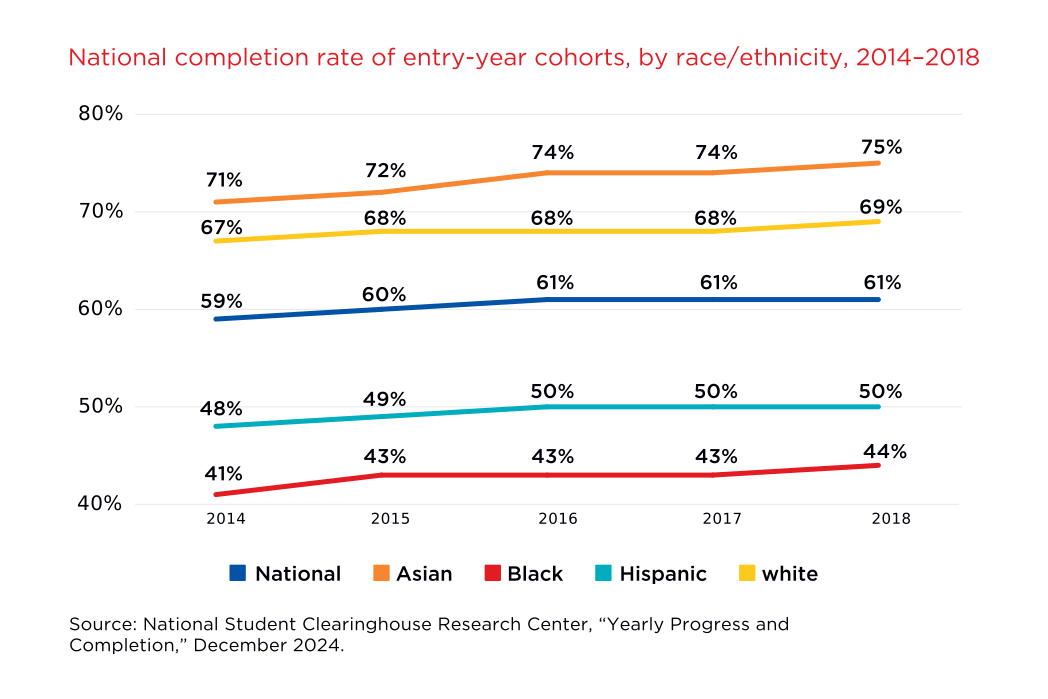
Six years after entering college in 2018, 50% of Latino students had completed degrees compared to 69% of white students and 61% of all students overall — a completion gap of more than 19 points and 11 points, respectively.
32%
32% of those enrolled in for-profit two-year institutions are Latinos, even though Latinos make up only 20% of all college students overall. For-profit institutions have been result in lower completion and higher debt and default rates.
National Completion Rate
The college completion gap for Latino students has remained largely unchanged over time.
Six years after entering college in 2018, 50% of Latino students had completed degrees compared to 69% of white students and 61% of all students overall — a completion gap of more than 19 points and 11 points, respectively.
UnidosUS Survey of Latinos in Higher Education
To better understand and elevate Latino perspectives in higher education, UnidosUS conducts surveys, polls, and focus groups with Latino postsecondary students and Latino voters.
2 in 3
Latino students considered leaving school. One-third took a leave at some point.
85%
Latino students report being unable to get affordable and healthy food.
80%
Latino students report working either full-or part-time while attending college.
Citation Disclaimer - higher ed survey
Source – UnidosUS National Survey of Latinos in Higher Education (October 2024)
Value
Even after they earn a degree, many Latino students do not see the full economic return on their investment in higher education. Key challenges include student debt burdens, enrollment in programs with weak outcomes, and lack of access to paid internships and networks. Worse still, too many Latino students are defrauded by predatory institutions, leaving them with debt but no degree or path to a good job.
Fast facts 2
73%
Nearly three in four of Latino borrowers who considered leaving school stated not wanting to take on more debt as a key driving factor in their decisionmaking.
18%
of the Latino first-time college entrants in 2011-12 defaulted on their student loans within six years of completing their degree, compared to 12% of their white peers.
64%
Latino borrowers default at rates higher than their white peers. In the same cohort, Latino default rates varied by institution sector but were highest at for-profit colleges (57%) and lowest at non-profit (8%) and public institutions (35%).
Citation disclaimer for value
Source -UnidosUS Latino Banking and Financial Health Survey (June 2024)
- Recent 4-year college graduate
“Although more Latinos are pursuing college than before, barriers do still exist for our community, especially given that many of us are first generation students. For many of us, our parents and siblings did not attend college so everything that comes with attending is totally new to us and that is absolutely a struggle in and of itself.”

Latino policy agenda
UnidosUS is advocating at the federal and state levels to support better outcomes for Latinos in postsecondary education:
- Make high-quality colleges and universities more affordable for high-need students
- Make it simple and easy for economically disadvantaged students and parents to access and understand financial aid
- Ensure equitable enrollment and admissions processes across all public colleges and universities
- Increase degree attainment by investing in academic and comprehensive support programs for Latinos
- Ensure that Latino students earn quality degrees across all institutions
- Make student loans manageable and less of a financial risk to borrowers
- Ensure that racial and ethnic opportunity gaps in higher education are addressed by requiring institutions to report and use student outcomes measures to improve equity
- Diversify the teacher workforce to improve Latino student outcomes
Media coverage
Progress Report


Head Start: 60 years of empowering and strengthening families
December 22, 2025

Are TRIO Programs relics of the past? Latino students say no
November 14, 2025




Are changes to Public Service Loan Forgiveness unconstitutional?
September 26, 2025

How the budget reconciliation bill fails Latino students
September 19, 2025

Dreams deferred: Federal pressure revokes in-state tuition, college access
September 12, 2025

The threat to education funding is far from over
September 5, 2025

Saving Indiana’s Certificate of Multilingual Literacy
August 15, 2025




One voice: Supporting language rights
May 8, 2025


Multiplying educational success through math
April 15, 2025

The chilling effect of executive orders on education
April 10, 2025

A nationwide wake-up call: Our students are not all right
March 27, 2025

Publications & Resources
- Congressional agenda: Prosperity for All: A Latino Policy Resource for the 119th Congress (January 2025)
- Factsheet: Pell Grant: Unlocking Latino Economic Mobility (April 2024)
- Dreams Interrupted: A Mixed-Methods Study Assessing Latino College Completion (September 2021) – a qualitative companion to the quantitative findings of the report “Debt, Doubt and Dreams: Understanding the Latino College Completion Gap,” providing a more compelling understanding of Latinos’ hesitancy to take on educational debt.
- Examples of Student Success Programs for Latinx Students (August 2021). This resource outlines institutional evidence-based programs targeted at Latinx students at two-and four-year colleges and universities.
Contact us
If you have any questions regarding the information on this page, contact us at: [email protected]
Subscribe for updates
Stay updated with the latest trends in education with UnidosUS’s scholarly publications, insightful articles, and educational webinars!
Fuel our mission
Join the UnidosUS familia of individual donors building a stronger America by creating opportunities for Latinos. Click DONATE now or email us at [email protected].