
SURVEY: Latino families say current policies are not meeting their needs
By Julienne Gage, former UnidosUS web content manager currently working on a PhD in sociocultural anthropology at Florida International University; with contributions from UnidosUS staff Tania Villarroel, policy advisor, early childhood education.
Hispanic families share the challenges they face due to rising child care costs and how current policies are out of step with their needs, forcing many parents out of the workforce and limiting economic mobility.
Early childhood educators and parents are speaking candidly about the challenges of finding high-quality, affordable child care, which has risen in costs by 30% since 2020.
Arizona mom Julia Rodriguez painted a clear picture of what happens to so many Latino families trying to achieve the “American Dream.” The household income for her and her husband falls just outside the threshold for subsidized child care, making it impossible for both to work full-time or attend school. As a result, Rodriguez has been forced to stay home as the primary caregiver.
“We can’t afford more house, we can’t move up in our careers, we can’t afford to be living outside of these means, so this is where we’re at for the time being,” Rodriguez says in a video interview. “It’s like there’s no options for us.”
Stacey McGuire, executive director of Tots Unlimited Preschool in Glendale, Arizona, agrees with the notion that for too many Latino families, balancing child care and work is challenging, if not impossible. “If someone brought their child to me and their child is 4 years old and it’s $280 a week for child care, they can’t afford that if they’re taking a job that pays $19 an hour,” she explains.
Top survey findings
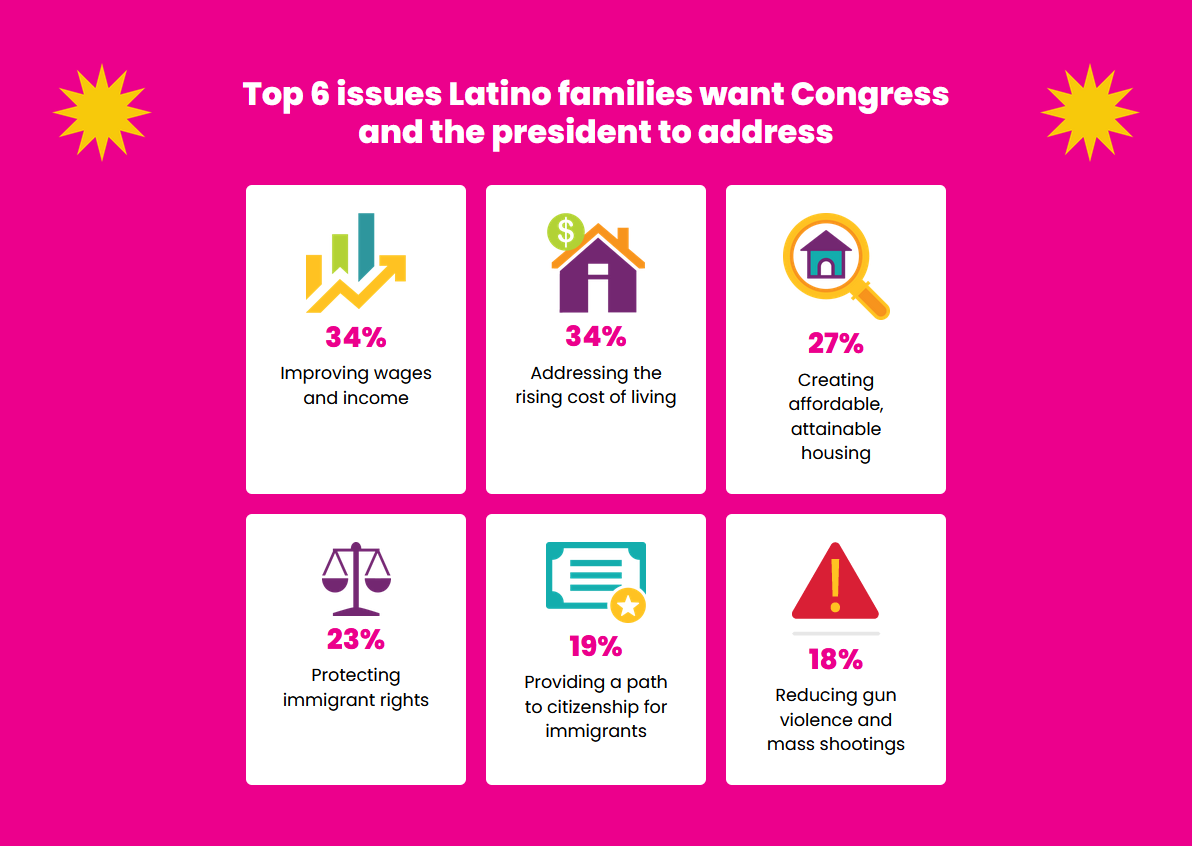 This year’s National Latino Family Survey, developed with AP-OD (Abriendo Puertas/Opening Doors) — UnidosUS’s partner on the Latino Infant Initiative (LII) —gathers insights from more than 1,000 Hispanic families with children under age 6 in California, Texas, Arizona, New Mexico and Florida about their most pressing social and political concerns. The 2025 survey was conducted just one month into President Trump’s second, non-consecutive term, and shows that Latino families want the president and Congress to improve their economic outlook and protect immigrants. The top six priorities: improving wages and income, addressing the rising cost of living, creating affordable housing, protecting immigrant rights, providing a pathway to citizenship, and reducing gun violence and mass shootings.
Dr. Gabriel Sanchez, PhD, vice president of research at BSP Research (the firm that conducted the survey) underscores what UnidosUS Affiliates and partners are still hearing today amid deep federal spending cuts, a historic 40-day government shutdown late last year, and continuing ICE raids and mass deportations.
“The clear picture is the economy and immigration,” he says, noting that these issues undermine Latino families’ ability to raise and educate their children in safe, culturally responsive environments and to contribute meaningfully to the nation’s social and economic fabric.
Specific to children’s well-being, the top six priorities for Latino families nationwide: high-quality child care and early learning (39%), improved protections for children against gun violence (37%), reducing the cost of college attendance (28%), resources for improved parent engagement (19%), parent engagement programs (18%) and a desire for high-quality dual language or bilingual programs (16%).
State-level reflections on early childhood issues
Teresa Granillo, chief executive officer of UnidosUS Affiliate AVANCE (a national, nonprofit early childhood education program based in Texas), notes that today’s policies run counter to what affordable access to programs like hers have shown — that children reap lifelong benefits from safe, nurturing and stimulating early childhood classrooms while parents become more empowered to look for work or pursue the training they need for upward financial mobility.
Granillo notes that a 2014 study AVANCE conducted with the Intercultural Development Research Association showed that families who had participated in AVANCE’s early childhood and parent engagement programs saw a 127% increase in employment and a 216% increase in obtaining higher educational degrees — all of which translates to stronger, more sustainable families and a stronger Texas economy.
“Texas is all about the workforce,” she says. “Let’s incentivize people to open centers and really have high-quality early education available for our workforce.”
Another issue weighing heavily on the workforce of the border state of Texas is the Trump administration’s intensive immigration crackdown, says Crystal Sandoval, director of cross border strategies at the El Paso-based organization Las Americas Immigrant Advocacy Center. Her team is working around the clock to keep up with immigrant requests for legal advice, especially from communities organizing to accommodate families separated by mass deportations. And their experiences are only intensifying, she notes.
The increasingly high cost of child care in Florida, which has the third largest Latino population in the country and one of the highest costs of living nationwide, is causing about 150,000 parents of children under the age of 6 to drop out of the workforce every six months.
“This is bad for the child for their development and it’s also bad for our workforce and our economy,” says Makayla Buchanan, chief of staff of The Children’s Movement of Florida, a UnidosUS partner. She adds that food insecurity in Florida — a major agriculture producer — is so high that food assistance programs have become a norm, not a temporary fix.
Thanks to the efforts of groups like The Children’s Movement of Florida and UnidosUS Florida Affiliate Redlands Christian Migrant Association (RCMA), early childhood advocates convinced the state legislature to increase the cap on its eligibility threshold for its School Readiness child care tuition assistance program from the federal rate of 50% below the poverty line ($46,800) to 55% of the state’s median income ($54,000) for a family of four.
“It’s not entirely that much better, but it’s a step in the right direction,” says Buchanan.
But no state nationwide has made as many strides in affordable and culturally relevant child care as New Mexico, where half of the 1.1 million Latino population — the largest of any state — live in poverty. Infant child care costs have risen to 86% more than the cost of in-state tuition for a public four-year college degree and 10% more than the state’s average rent costs. But in 2022, following a decade of grassroots organizing, the New Mexico state legislature passed what many early childhood advocates across the country have only dreamed of achieving: universal child care.
The decision, which came through a majority vote in favor of amending the state constitution, has increased child care assistance eligibility to 400% of the federal poverty level. Within two years, New Mexico has doubled its early childhood workforce. Teresa Madrid, executive director for the Albuquerque-based Partnership for Community Action, explains that one of the ways New Mexico has achieved this is by investing in high-quality registered and licensed providers, including home-based providers.
“Supporting those home-based providers to offer that quality of care to families in the language that they want is going to be an important step for letting universal child care come to fruition, successfully,” Madrid explains.
State-level results from the 2025 National Latino Family Survey shows that 93% of families in New Mexico want their children to be bilingual — an everyday reality in a state where more than 50% of the population speaks a language other than English at home. That’s music to the ears of early childhood advocates.
“We know so much more about the brain than we did even 20 years ago…kids who grow up bilingual…[it has] such an impact on their brain development and it serves them so well not only in youth but also later in life,,” Javier Martinez, managing director of National Policy for Abriendo Puertas/Opening Doors, explains.
The bigger question is how to ensure that early childhood educators who speak other languages at home are credentialed and strive for high educational levels.
“We rely on [these educators]. We need them. But, if you’re an early childhood educator in New Mexico and you speak Spanish only, you hit a wall once you get to your associate’s degree, you can’t go any further,” Martinez says. “We need bilingual higher ed programs [for early childhood educators].” Without accessible credential pathways in Spanish, the state effectively caps the advancement of the very workforce it depends on to serve multilingual families. Expanding bilingual higher education options is not just an equity issue for educators, it is a structural necessity for building a qualified, culturally responsive early childhood systems.