Head Start: 60 years of empowering and strengthening families
By Julienne Gage, former UnidosUS web content manager currently working on a PhD in sociocultural anthropology at Florida International University. With contributions from Tania Villarroel, policy advisor, early childhood education, UnidosUS.
Summary: For 60 years, Head Start has helped more than 40 million children and their families. This federal program provides education, nutrition, health screenings and family support during the most critical years of brain development. Today, recent federal actions are raising the alarm for UnidosUS and its partners — actions that threaten to deny critical funding and access to vulnerable families.
Sixty years is often a celebration, and while UnidosUS and its partners celebrate Head Start, they must also sound the alarm over new federal policies and budget shortfalls that threaten to roll back decades of progress. These concerns are particularly urgent in the context of the recent federal government shutdown, which delayed funding, disrupted services for vulnerable children and families, and exacerbated existing inequities in early childhood education.
Since its founding in 1965, Head Start has helped more than 40 million children and their families overcome financial barriers and improve educational and health outcomes. Head Start is not just preschool: it provides education, nutrition, health screenings and family support during the most critical years of children’s brain development. UnidosUS, established just three years after Head Start’s founding, has partnered closely with the program for decades, shaping and informing best practices in education policy while advocating for equitable access across communities.
Today, Head Start remains a top legislative priority for UnidosUS, included in both its policy recommendations for the 119th Congress and its Latino Infant Policy Agenda, which serves as the backbone of the organization’s national Latino Infant Initiative (LII) – in collaboration with educational partner AP-OD (Abriendo Puertas/Opening Doors).
But a recent reinterpretation of the Personal Responsibility and Work Opportunity Reconciliation Act (PRWORA) has raised new concerns for Latino families with young children. Delivered in the form of a July 10, 2025 directive from the U.S. Department of Health and Human Services, programs like Head Start are being classified as “federal public benefits” instead of education programs. This means that in many states, undocumented children could now lose access to enrollment. This marks a sharp departure from nearly two decades of recognizing Head Start as an early learning program open to all children.
“This decision undermines the fundamental commitment that the country has made to children and disregards decades of evidence that Head Start is essential to our collective future,” National Head Start Association Executive Director Yasmina Vinci said in a July 10 statement.
The PRWORA rule isn’t being applied uniformly across the country. Courts have temporarily blocked it in 20 states and the District of Columbia. Additionally, nonprofit organizations that provide Head Start services would be exempt from this reinterpretation.
“For families, the takeaway is simple: programs like Head Start remain essential pathways for school readiness and family stability,” says Hannah Valdiviejas Cohn, early childhood education policy analyst at UnidosUS. “Despite attempts at policy changes in Washington, many states and local communities are doing everything they can to keep early learning open to every child.”
A dangerous double bind affecting many Latino families
Because roughly 40% of Head Start participants are Latino and one-third are dual language learners, many advocates worry this federal policy will discourage immigrant families from seeking early education opportunities that their children are eligible for and depend on for school readiness.
And immigrant families now face a dangerous double bind. The Department of Homeland Security’s recently proposed rule, known as the public charge rule, would allow immigration officials to deny green cards based on a family’s past or potential use of basic services like health care or nutrition assistance (for example Medicaid and the federal Supplemental Nutrition Assistance Program). This directly compounds the confusion already created by the proposed reinterpretation of PRWORA, which threatens to restrict undocumented parents from enrolling their children in Head Start programs.
Although not enacted and still in the courts, these combined policies create a powerful chilling effect. Families who have always been welcome in Head Start may now fear that even accessing early learning or health services for their U.S. citizen children could jeopardize their chance at gaining residency status. For mixed-status households who rely on Head Start’s comprehensive supports, the message is clear and harmful. The price of seeking a green card may require sacrificing their child’s learning, safety or well-being.
A well-documented legacy with proven results
Head Start’s legacy of preparing young children for the foundational years of education is well documented. Data from Head Start’s 60th anniversary fact sheet shows that children who participate in the program are:
- 12% less likely to live in poverty as adults.
- 29% less likely to need public assistance.
- 2.7% more likely to graduate from high school.
- 8.5% more likely to enroll in college.
- 39% more likely to complete college.
New federal limitations in accessing Head Start come at a time when Latino children are projected to make up more than half of the K–12 public school population by 2050.
“UnidosUS and its partners believe that limiting enrollment to any part of this network — especially for immigrant families — puts vulnerable children at risk and threatens the nation’s future workforce and community stability,” said Valdiviejas Cohn.
Thanks to its robust research and evidence-based practices, Head Start curricula serve as a model that provides educators, policymakers and families with the latest data on prenatal and early childhood development. This data contributes to school readiness through learning, social and emotional development, language and literacy, cognition, and physical development.
The Latino Infant Initiative credits Head Start with actively engaging parents as their children’s earliest educators, providing them with hands-on, culturally and linguistically relevant training in cognitive and emotional development, as well as tracking and monitoring their health and linking them up to related public services during and after pregnancy. It also hails Head Start’s efforts to provide career pathways by helping parents to work on their education or join apprenticeship programs.
Policies should increase access to education, not restrict it
It’s a far cry from the early childhood experiences of low-income families prior to Head Start’s existence. In 2020, then East Coast Migrant Head Start Project CEO José Villas tells UnidosUS that as a young boy growing up in a migrant farmworker family, he was often the one to bathe, feed and supervise his infant and toddler siblings all while trying to get himself to school. And while he overcame insurmountable odds to finish high school and eventually obtain a doctorate in education, he was clear that he, his siblings and their parents deserved so much more, and that providing more to other vulnerable families would significantly improve their chances of fully participating and prospering in American society.
“I need to address the prenatal care of parents,” Villa says. “I need to address the care of children zero to three so that they can be prepared, so that we can provide them with the tools to make that transition into public school.”
Since its inception, Head Start has ensured that children can be children and have developmentally appropriate care and curriculum. Cleo Rodriguez, executive director of the National Migrant and Seasonal Head Start Association, says he can think of thousands of examples of Head Start graduates who went on to college and became competitive in fields such as education, neuroscience or public administration.
“These are youth with two or three majors in college, they’re making the dean’s list, and so many of them go back and say that Head Start was the cornerstone — the fact that they felt safe, that their parents were engaged, and that somebody cared,” Rodriguez says. “We should consider opportunities and initiatives to increase access, not limit access. Every child who is qualified for Head Start should be offered this life-changing experience so they too can advance their choices and opportunities in life. “
And because Head Start is generally run by representatives of the people it serves, its staff are able to respond with hard-won wisdom in what those empowering and strengthening opportunities look like.
“I think that the greatest achievement is the fact that Head Start has created an army of individuals who have been able to lift themselves out of tough social circumstances,” Rodriguez says.
Local, culturally responsive solutions led by Affiliates
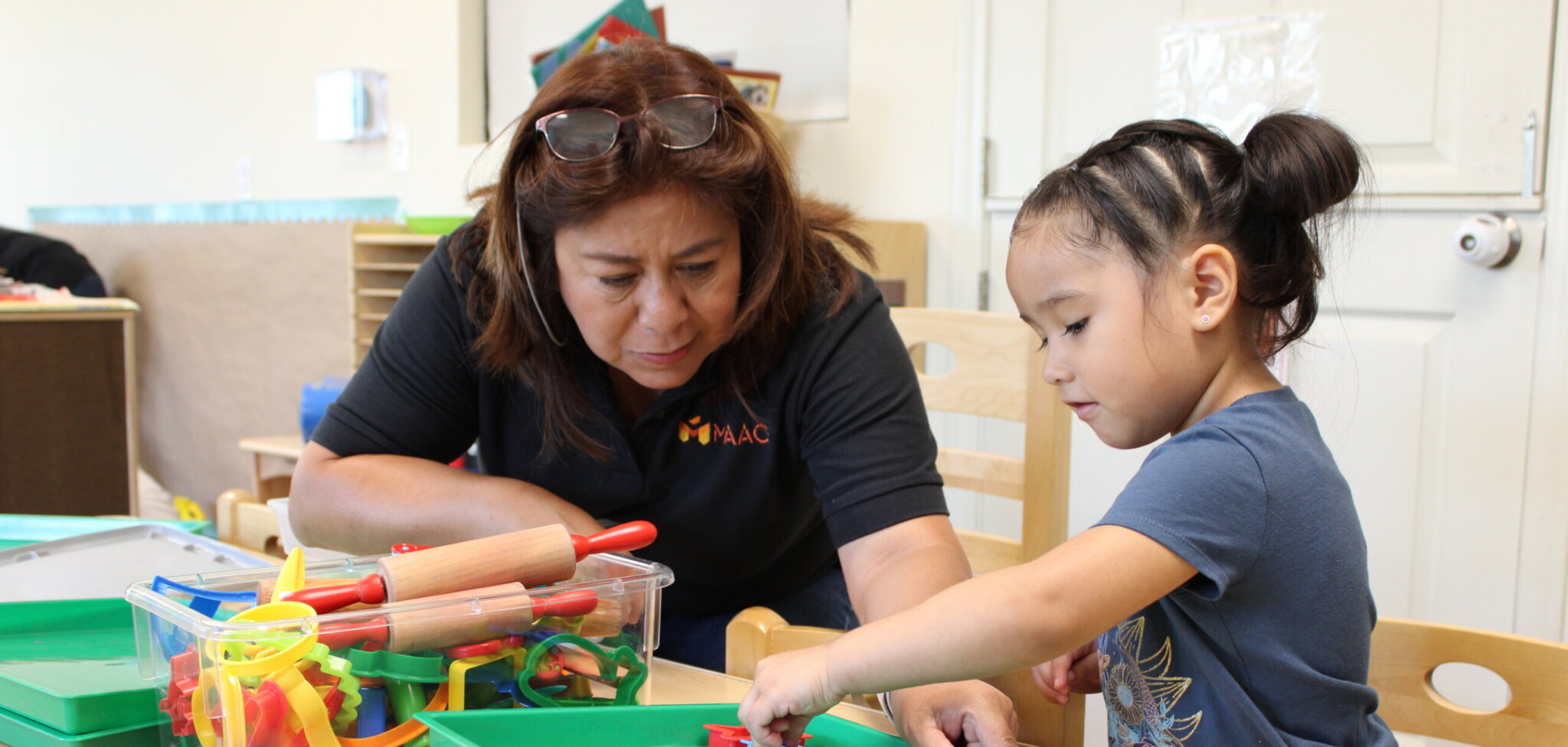
In southern California, UnidosUS’s San Diego-based Affiliate Metropolitan Area Advisory Committee on Anti-Poverty of San Diego County, Inc. (MAAC) is also reeling from the news amid celebrations of both Head Start and MAAC’s 60th anniversaries. MAAC has a $69 million budget to run child development programs, a charter high school, workforce development programs, drug and alcohol recovery programs and a real estate development program to create affordable housing solutions.
Through Head Start funding, MAAC directly operates 17 area child development centers and partners with six others, and subcontracts with 24 family-based childcare centers, currently serving about 1,200 children and their families. That funding, which helps to employ 320 staffers, accounts for 90% of MAAC’s Head Start programming with the remaining 10% coming from the state of California.
Local innovation within MAAC has helped the organization reach several other top LII priorities, access to early education centers and better pay for early childhood educators.
News of the latest federal directive on undocumented families hit Arnulfo Manriquez, MAAC President & Chief Executive Officer especially hard. He came to MAAC in 2003 as an affordable housing developer just as he was becoming a parent.
“I had attended the grand opening of a MAAC apartment complex in 1994 and thought ‘wow, that’s an organization that I want to go work with, because MAAC was more than housing. It provides all the support needed to help families become self-sufficient,” he says.
Over more than two decades, Manriquez has helped build nine preschool facilities, and today, he is working on the design of six pre-school classrooms that will be embedded in affordable housing developments.
The more Manriquez learned about early childhood education, the more he was able to pivot his role into accommodating community needs, including the talent needed to teach Head Start children. For example, after the pandemic, MAAC was struggling to find educators to fill empty classrooms with children waiting to start. MAAC took a lead in statewide calls to increase the salaries of early childhood educators by matching them to local K-12 wages with educators and key support staff receiving an average 24% increase in their salaries, quickly accommodating the classrooms it was running with bilingual staff who were familiar with the needs of the community.
“As a Head Start provider, our mission has always been to support the healthy development of children and families who are eligible for services, including those with legal immigration status,” Manriquez says. “We understand and follow all federal regulations, but we’re also mindful of how policy changes, like the recent reclassification of Head Start as a public benefit, can create confusion and fear for families who are on the path to citizenship. Many immigrant families come to this country with limited resources, working hard jobs at low wages, and Head Start plays a critical role in helping them stabilize and grow. We remain committed to ensuring that eligible children receive the support they need during these foundational years.”
Essential workers in the agricultural sector
Just days before the July 10 federal directive aimed at restricting undocumented immigrants’ access to Head Start, Rodriguez was hailing the way his program, Migrant and Seasonal Head Start, had advocated in Congress in recent years to keep the program open for children in which one parent was working in agriculture.
“The requirement in our program is that our families work, and 100% of our families work in agriculture. They were deemed essential workers during the pandemic, during the first Trump administration,” says Rodriguez, noting that Migrant and Seasonal Head Start has conducted comprehensive research showing how its agricultural families and its nearly 200 employees had contributed to the economy, especially in rural areas. “That’s $12+ billion dollars funneled into this economy. You compromise that and it has a huge impact in every corner of the United States.”
This latest federal government shutdown, the longest in U.S. history, shut 9,000 children in 17 states (20 Head Start programs) out of their Head Start classrooms because grants were delayed. But the disruptions didn’t end with the return of elected officials to Washington. Even as services are officially reinstated, there will probably be a massive backlog of administrative processes.
All of these concerns are further exacerbated by the logistical and emotional toll of increased immigration enforcement.
“We’re talking to Head Start program facilitators who have had to quickly accommodate children whose parents were picked up by ICE, placing an immense burden not only on these families, but also the professional staff running the critical programs,” says Valdiviejas Cohn.
“Experts are seriously concerned about the lasting impact of these disruptions because Head Start is not just an education program — it’s part of our nation’s economic infrastructure, it helps keep parents in the workforce,” said Valdiviejas Cohn. “When programs close, parents miss work or must leave jobs entirely. That hurts families and weakens local economies.”