Are TRIO Programs relics of the past? Latino students say no
By Magin Sanchez, Senior Policy Analyst, Higher Education, UnidosUS
Claiming college access is no longer an obstacle, the Trump administration is dismantling Federal TRIO college preparatory programs by eliminating staff and withholding funds that serve more than 650,000 low-income students. UnidosUS asked Latino college students what they think about losing this critical support.
Amid the longest federal government shutdown in history, the Trump administration laid off the entire office of staff who were supporting Federal TRIO Programs — the latest blow to the federally funded college outreach and support programs that served more than 650,000 low-income and first-generation students through college.
A federal judge paused the job cuts, and the deal Congress passed this week to re-open the government requires the Trump administration to reverse mass layoffs and halt terminations until –Jan. 30 — the next deadline for lawmakers to finalize the fiscal year 2026 budget. It remains unclear what will happen to these jobs once the deal expires.
Even with the temporary reversal, the future of TRIO programs hangs in the balance. President Donald Trump’s funding priorities for the upcoming fiscal year axes these programs, calling them “relics of the past.”
TRIO Programs are a lifeline for Latino students, who are much more likely than other racial or ethnic groups to be the first in their families to attend college. In fact, nearly half (46%) of all Latinos are first-generation students.
As the Trump administration moves to scale back these time-tested programs and other critical support systems, UnidosUS partnered with Hart Research to hear directly from Latino college students and recent graduates from across the country — and across political affiliations. The consensus? A deep concern about what losing outreach and support programs means for their futures.
Across the political spectrum, students reject the notion that college access is no longer an obstacle for low-income students.
“While college access has improved, it’s still a big obstacle for many students with limited means,” a freshman from Florida who self identifies as a strong Republican shared during the discussion group. “Just getting accepted isn’t enough. There are still issues like paying for housing, food, books and knowing how to navigate the college system. A lot of students still need extra support to even get to that starting line, so I don’t think access is a solved problem yet.”
Another student, a freshman, who self identifies as Democrat, from Florida, said, “These programs provide critical support, such as tutoring, mentoring, college application assistance and guidance that can make the difference between a student dropping out or graduating.”
Research affirms that advising, tutoring, financial guidance and mentorship provided by TRIO Programs play a role in getting these students to graduation day.
Established in 1968 as part of President Lyndon B. Johnson’s “Great Society” initiatives, TRIO Programs have benefited from decades of bipartisan support before the White House tied the programs to so-called “woke ideology,” and affirmed, “Today, the pendulum has swung, and access to college is not the obstacle it was for students of limited means.”
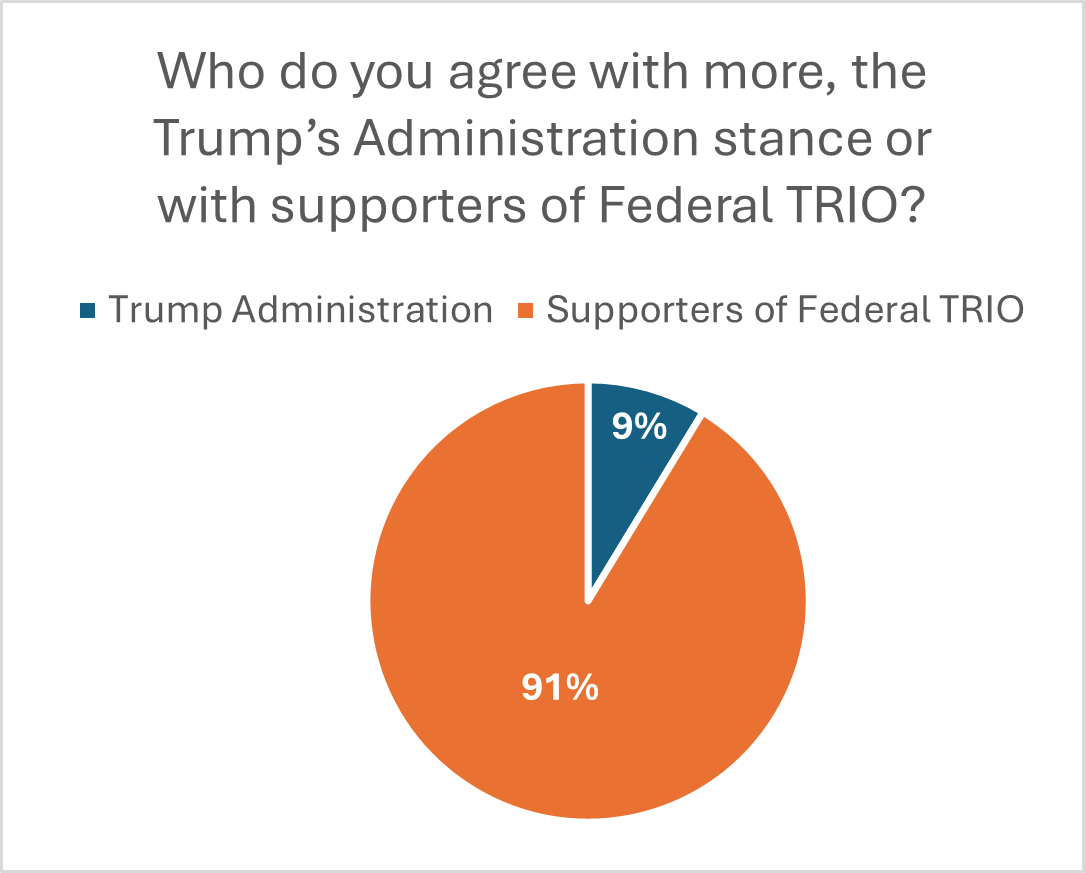
Students of all political persuasions felt differently and recognized that these programs bridge the gap between those who have resources and those who do not — or lack access to resources.
“There are still absolutely so many obstacles facing students from lower income households, students of color, and first gen students,” a senior from Indiana, who self identifies as Independent, shared. “It is absolutely ridiculous to state that college is equally accessible to all families of all backgrounds.”
In the months since, the Department of Education was slow to disburse grants and funding. In some cases, it outright withheld TRIO Program grants, according to the Council for Opportunity in Education. The delayed $600 million in funding affected more than 2,000 programs and roughly 650,000 students nationwide. Additionally, about 120 grants for programs that referenced diversity, equity and inclusion were canceled or rejected, impacting 43,600 students.
“When government ends support to less privileged individuals, nations stop growing,” said a sophomore from California, who self identifies as Republican. “One well educated country has well prepared workers and intelligent urgent citizens. When governments stop supporting, there is no progress.”
More broadly, students’ priorities and perspectives on postsecondary education often differed from those of the Trump administration across TRIO Programs, Pell grants, federal student loan repayment programs and more. Many students couldn’t even name how the Trump administration was helping students like them.
“I’m really disappointed with some of the policy changes announced in the Trump administration,” said a sophomore from California, who self identifies as Republican. “Many hardworking students aren’t able to finish their careers with these actions taken by the Trump administration. Life is getting harder in this country for everyone.”
Another student from California, a senior, who self identifies as Independent, expressed anger and frustration. “Who in their right mind would want to make it more difficult for the next generation of educated individuals to achieve their goals and make the process all the more tiresome?”
Our research makes it clear that college students, especially Latino students, are working harder than ever to succeed. Yet they still feel their needs and priorities are overlooked. Students across the country and across political affiliations affirmed how programs like TRIO are helpful and essential.
These students are speaking up about what they need to succeed. But will the Trump administration listen?
Methodology: Earlier this year, UnidosUS partnered with Hart Research to listen directly to Latino college students and recent graduates from across the country. Using an online discussion forum platform, 24 participants engaged in guided conversations about various higher education issues, including reacting to statements from the Trump administration and education advocates.