How the budget reconciliation bill fails Latino students
The budget reconciliation bill, known as the “One Big Beautiful Bill” Act, made the largest cuts to higher education funding in U.S. history. The consequences of this will result in higher costs, which may force students — especially Latino students — to abandon advanced education degrees or to take on even more student loan debt at a time when loan repayment terms have also worsened.
By Magin Sanchez, Senior Policy Analyst, Higher Education, UnidosUS
A college degree just got a lot more expensive. It’s the consequence of one of the largest cuts to higher education funding in U.S. history.
In early July 2025, President Trump signed into law the budget reconciliation bill, often referred to as the “One Big Beautiful Bill” Act. This bill reduces federal education funding by $284 billion. These funds, previously allocated to education, will now be used to pay for tax cuts for the ultra-wealthy and increased immigration enforcement. But what does this mean for students, including Latino students?
Early analysis shows the cost of higher education will become too high for many, forcing students to abandon college altogether or take on unsustainable debt from more expensive sources. This legislation, passed by Congress:
- Imposes unrealistic student loan repayment terms.
- Restricts graduate loans.
- Strips consumer protections against fraudulent institutions.
The following are some of the key provisions impacting Latino students.
Key higher education reconciliation provisions:
1. New graduate student loan limits
Starting July 1, 2026, prospective working-class Latinos may find it virtually impossible to become high-earning professionals due to new lending limits on federal graduate loans.
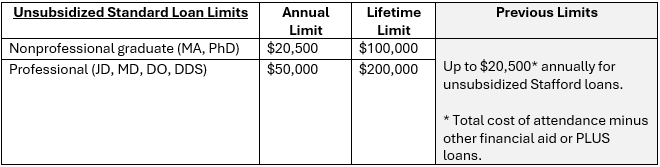
This is particularly true for students in high-cost graduate programs, who easily exhaust their lifetime loan limits when attending medical school or law school. According to an analysis from the Association of American Medical Colleges, 56% of medical school graduates held $200,000 or more in educational debt, exceeding the new lifetime borrowing limit set by Congress.
In addition, graduate and professional students will no longer have access to grad PLUS loans, a credit-checked loan program used by 10.6% of Latino graduate students.
In 2019, over half of Latino graduate students relied on federal loans to finance their studies. Eliminating access to such loans will push more students into the more expensive private loan market, which lacks the same consumer protection as federal loans.
Ultimately, higher education warn that students who aspire to be doctors or lawyers must either obtain private loans with higher interest rates and fewer consumer protections or abandon their career pursuits altogether.
2. New student loan repayment plans
How borrowers pay back their student loans will change dramatically. Starting in 2026, existing student loan repayment plans will be phased out, leaving borrowers with two options to repay their loans:
- Standard Repayment Plan: Fixed monthly payments over 10-25 years, dependent on the amount of federal loans taken out by the student.
- Repayment Assistance Plan (RAP): Where a percentage of the borrower’s income is used to calculate the monthly payment amount. Borrowers can remain in the plan for up to 30 years.
Compared to the existing SAVE plan, an income-driven repayment (IDR) plan, the typical current loan borrower with a college degree will be forced to pay an additional $2,929 per year ($244 a month) under RAP.
Such increased expenses come at a time when the cost of living remains the top concern for Latinos. In 2022, estimated 5.3 million Latinos hold student debt, with over half of Latinos reporting already struggling to keep up with their student loan payments.
In fact, the budget reconciliation bill also eliminates the option that allows borrowers struggling with unemployment or other economic hardships to temporarily delay making payments. Such changes are projected to be devastating to Latino borrowers, as 56% have reported using forbearance or deferment to pause their payments temporarily.

3. Pell Grant eligibility changes
Federal Pell Grants — funds that, unlike student loans, typically do not need to be repaid — provide critical financial aid for half of all Latino undergraduates. Although the worst provisions regarding cutting Pell Grants were removed before the bill’s final passage, The funding for the Pell Grant program is already stretched thin. Adding new recipients without new funding or guardrails to protect students from low-quality programs, threatens to trigger the same eligibility cuts that hurt students in previous years. Congress had previously cut access to Pell Grants when the program ran out of money.
73% of Latino college students who considered leaving college cited debt concerns as a major factor. Reducing Pell Grant eligibility would only exacerbate this problem, further widening the Latino college completion gap.
Additionally, the makes the following changes to Pell Grant eligibility:
- Eliminates eligibility for those with a Student Aid Index (SAI), a formula-based number indicating financial need, twice the amount of the maximum Pell Grant. This is likely to impact those with higher assets compared to income.
- Eliminates eligibility for those receiving non-Title IV, non-federal grant aid — such as student athletes with full-ride scholarships or free-college programs, which cover the students’ full cost of attendance.
4. Stripping consumer protections
The budget delays much-needed consumer protections against fraudulent and predatory colleges for 10 years. In the meantime, Trump-era regulations will remain in place.

These reinstated Trump-era rules were found to be widely ineffective, forgiving only 3% of loans affected by school misconduct. Students who experience a school closure or find themselves defrauded by their institutions find little relief under these rules.
Most borrowers impacted by misconduct attended for-profit colleges, which have a longstanding history of negative outcomes for Latino students. By delaying and effectively repealing these consumer protections, the most vulnerable students and taxpayers are left to bear these costs.
5. Undermining Medicaid and SNAP
The budget reconciliation bill slashes more than $1 trillion from Medicaid and the Affordable Care Act, and $187 billion from SNAP, the food assistance program. Higher education cite these cuts as the largest cuts to health care and anti-hunger programs in U.S. history. Such cuts will sharply increase costs for states and households, leading to significant reductions in state spending.
Students who rely on these services (currently, 3.5 million college students rely on Medicaid) will be left devastated. Such cuts will amplify the lack of Latino student health coverage, as just 13.1% of Latino students already lack health coverage, compared to 7.7% of all students.
Furthermore, according to a 2024 UnidosUS survey, 85% of Latino college students are unable to get affordable and healthy foods. Historically, when states face budget crunches, higher education funding is often the first to be cut. Great Recession-era cuts to per-student spending took nearly a decade to recover, and tuition never returned to its 2008 levels.
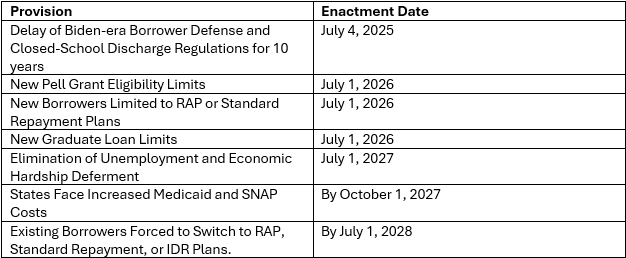
Timeline of key provisions
Looking ahead
Starting in late September , the Department of Education will undertake a rulemaking process to begin implementing many of the provisions passed in the reconciliation bill.
Questions remain about how the department will be able to efficiently implement this bill, given the reduction in staffing since the beginning of the Trump term. But, regardless, the damage to Latino students is projected to be profound and long-lasting.
Education is intended to open doors, but this bill locks too many of our students out and is one of the largest redistributions of wealth from working-class Americans to the ultra-wealthy. The consequences will linger for generations — for Latino families who will be blocked from accessing well-paying jobs, and for local communities who will be losing out on future doctors, lawyers, and other professionals due to the high and unattainable costs of college.