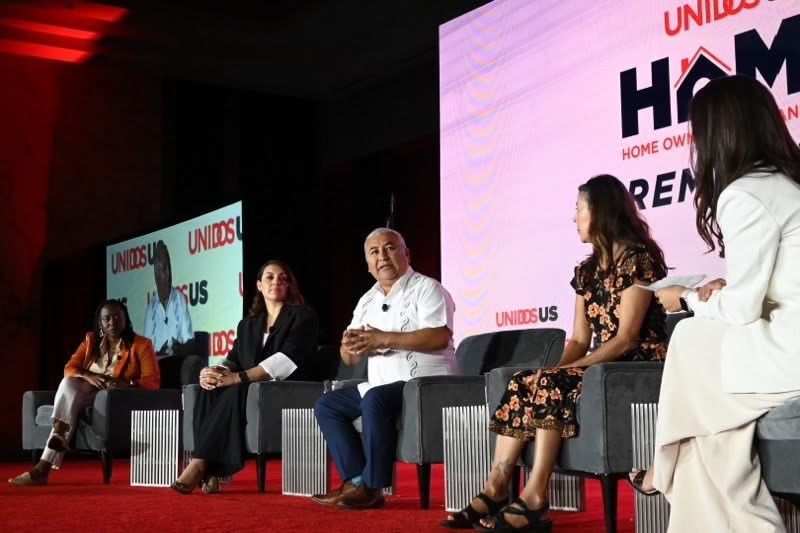
HOME: Investing in Latino families, communities and the future of homeownership
By Fatima Sierra Vargas, senior program manager, Economic Initiatives
Latino families face major barriers to homeownership, from rising housing costs to unequal access to lending, which limit opportunities to build generational wealth. In response, UnidosUS launched the Home Ownership Means Equity (HOME) Initiative to expand access to credit, increase affordable housing and strengthen pathways to homeownership for Latino communities.
Since 2023, HOME has invested more than $3.3 million in community-driven solutions across the country, supporting innovative housing models, workforce development and local partnerships that help families build long-term economic stability and wealth.
As of 2022, Latino households held just 22 cents for every dollar of wealth held by white households — a gap rooted in generations of policy decisions, according to a UCLA Latino Policy & Politics Institute (LPPI) and UnidosUS report. At the center of that divide sits homeownership, which is the primary driver of wealth-building for most families and a path that is becoming increasingly difficult to navigate.
Across the United States, rising housing costs, limited inventory and persistent structural barriers have created a housing landscape where opportunity is unevenly distributed. According to the National Association of Hispanic Real Estate Professionals’ “2025 State of Hispanic Homeownership Report,” home prices and mortgage rates remain high, while limited housing supply continues to drive affordability challenges — particularly for Latino households, whose median incomes are lower than those for white households.
These challenges are compounded by systemic barriers that continue to slow progress. In 2024, Latinos faced a mortgage denial rate of 22%, nearly double the rate for white and Asian applicants. The Federal Reserve’s “2024 Survey of Household Economics and Decisionmaking” echoes this, finding that Hispanic households were less likely to own and more likely to rent than white and Asian households and that homeownership among lower-income adults, a group that disproportionately includes Latino families, stood at just 35%. This disparity is not simply a product of income differences; it reflects a lending environment that has made it harder for Latino families to access financing. The result is a reinforcing cycle: Limited access to homeownership means limited wealth accumulation, which in turn makes the next generation’s path even more difficult.
And yet, the demand for homeownership remains strong and growing. A recent Julian Bond Institute (JBI) 2050 survey found that 86% of Americans across races and generations viewed homeownership as a core financial goal, and Hispanic Americans continue to aspire to homeownership at high rates despite barriers that leave many unable to achieve it. Hispanics saw a net gain of 441,000 owner-households in 2025, reaching a record high of 10.2 million Hispanic owner-households nationally. Looking ahead, Latinos are projected to account for 70% of net new homeowners over the next two decades, underscoring their central role in the future of the U.S. housing market.
A National Response: The Launch of HOME
Recognizing both the urgency of these challenges and the opportunity ahead, UnidosUS launched the Home Ownership Means Equity (HOME) Initiative in 2023. HOME was designed as a direct community-driven response to the structural trends shaping Latino homeownership. HOME’s goal is to transform the economic trajectory of Latinos by advancing systemic change to add 4 million new Latino homeowners by 2030, advancing long-term mobility and wealth building.
At its core, HOME focuses on:
- Expanding access to credit.
- Increasing the supply of affordable homes.
- Strengthening homebuyer readiness.
- Preserving and protecting homeownership as a pathway to generational wealth.
Turning Vision into Impact
Since its launch, HOME has translated vision into action, surpassing a major milestone of $3.3 million in grant funding awarded to local communities nationwide. In partnership with national and local organizations, this investment is already producing measurable change on the ground. Through HOME, UnidosUS has:
- Funded 34 organizations across 13 states (Arizona, California, Florida, Georgia, Illinois, Maryland, Michigan, Minnesota, New Mexico, North Carolina, Ohio, Oregon, and Texas) and Puerto Rico.
- Launched Premio HOME, a national competition that elevated innovative solutions to address the shortage of affordable homes.
- Created the Local Keys Collaborative: a two-year, locally led, cross-sector homeownership campaign that expands access to homeownership by strengthening coalitions, building new partnerships and deepening local capacity.
- Collaborated to develop initiatives that address both housing supply and workforce development, increasing the construction of starter homes while creating pathways to careers in homebuilding.
- Funded community-driven innovations that respond to evolving political and economic pressures affecting housing access, ensuring solutions remain relevant and locally grounded.
- Supported disaster rebuilding and resiliency efforts, reinforcing a commitment to helping communities prepare for, recover from and rebuild following natural disasters.
Local Impact: Stories from the Community
Behind every dollar invested is a family, a community and a story. These three examples illustrate how HOME is funding a difference on the ground:
- Innovating Housing Construction: Hacienda CDC (Portland, OR)
Hacienda Community Development Corporation (CDC) developed the Mass Casitas initiative, an innovative effort to expand affordable housing in Oregon through mass timber modular construction. In December 2022, Hacienda CDC began the prototype phase of Mass Casitas. Since then, it has transported six homes to pilot the design, manufacturing and implementation of these modular units across the state of Oregon. The approach cuts building costs and timelines while producing high-quality homes — a combination that is critical in a state facing housing shortages. The initiative also includes a workforce training program that prepares builders and carpenters to work with the engineered wood systems used in affordable housing development, creating career pathways while simultaneously expanding housing supply. - Reclaiming Vacant Land for Generational Wealth: The Resurrection Project (Chicago, IL)
On Chicago’s South Side, The Resurrection Project’s (TRP’s) Back of the Yards initiative is turning vacant lots into homes. Part of a broader Reclaiming Chicago effort, the campaign converts vacant lots into affordable homes for working families in historically disinvested neighborhoods. For the families who purchase these homes, the impact goes beyond shelter; it is a stake in a community they have long called home and the beginning of a wealth-building legacy they can pass on. To date, TRP has built 19 new homes and is building 28 additional homes this year in Back of the Yards. - Advancing New Models for Affordable Homeownership: Casa Familiar (San Ysidro, CA)
Casa Familiar is pioneering a first-of-its-kind model for affordable homeownership. Its Avanzando San Ysidro Community Land Trust is the first program in California to leverage low-income housing tax credits (LIHTC), a tool traditionally used for rental housing, to develop 103 homes for purchase. The model creates a viable, replicable pathway to long-term homeownership that other communities across the state and nation can learn from and adapt.
These three initiatives represent just a fraction of the work underway across HOME’s national network. Each reflects a reminder that closing the racial homeownership gap requires solutions that are locally designed, community-rooted and built for the long term.
Looking Ahead: Building on Momentum
For HOME, the work is far from over. Through HOME, UnidosUS is not only investing in programs but also advancing a broader vision for economic mobility.
This includes continued advocacy on the HOME policy agenda, which focuses on expanding access to credit, increasing housing supply and protecting homeownership as a source of generational wealth. The continued work is also inseparable from the UnidosUS Economic Prosperity Agenda, which seeks to ensure that Latino families can fully participate in and benefit from the nation’s economy and that the economic contributions of Latino households are recognized. Homeownership is not just a housing goal; it is an economic one, the mechanism through which families build equity, weather financial shocks, fund education and create something to pass on.
With 10.2 million Latino homeowners ready and 70% of net new homeowners projected to be Latino over the next two decades, the future of homeownership is, in many ways, a Latino story. HOME exists to make sure that story is one of access with a pathway to generational wealth.