
The Higher Education Act opened doors for 60 years; its legacy is now at risk
Sixty years ago in November, President Lyndon B. Johnson signed the Higher Education Act (HEA), a law that recognized high academic achievement as a pathway to greater societal and economic participation. The law created federal financial aid grants, work-study programs and low-interest loans, and it bolstered funding and resources for campus libraries and programs that serve underserved students.
This legislation was among dozens of civil rights laws that Johnson enacted under his vision of creating a “Great Society” with the goal of ensuring everyone could live free of discrimination and enjoy equal access to voting, health care, housing, education and the job market.
UnidosUS remembers Johnson as a man who built his vision from firsthand experience. As a white southerner, he began his career in the late 1920s teaching fifth, sixth and seventh graders in a segregated school for Mexican migrant children in his home state of Texas. Since that time, Latinos have gone from representing only about 1% of the population to 20%, and the HEA has contributed to their success. UnidosUS’s research shows Latino enrollment in institutions of higher education has grown from 782,400 students in 1990 to 3.7 million students in 2020, though enrollment has not kept pace with growth in the overall population.
“To thousands of young men and women, this act means the path of knowledge is open to all that have the determination to walk it,” Johnson said in his speech for the signing of the HEA at the Southwest Texas State College in San Marcos, Texas. Today, this ideal faces its greatest threat.
Making higher education more affordable
 At its root, the HEA sought to get more low- and middle-income students into and through college by making it more affordable with grants and loans. But to do that, it had to establish and document benchmarks for financial need, so the government created what is now known as the Free Application for Federal Student Aid, a form that helps determine what level and type of financial aid students need.
For Latinos, one of the most important forms of financial aid under the HEA is the nonrepayable Pell grant for students with exceptional need. Nearly half (49.5%) of all Latino undergraduates receive Pell grants, compared to 40% among the general student population.
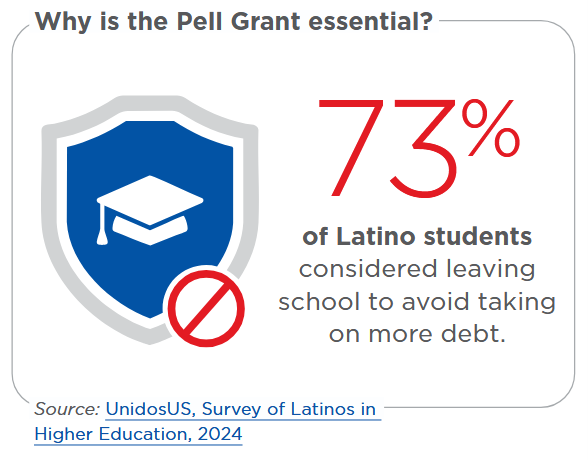
“The tools created by the Higher Education Act as the law evolved over time have been crucial to ensuring Latino student success,” said Magin Sanchez, UnidosUS’s senior policy analyst for higher education. “The Pell grants, for example, have been a game changer in helping Latino students stay the course, especially when you consider that 73% of Latinos who have considered dropping out of college, do so to avoid taking on more debt.”
Supporting low-income, disabled and first-generation college students
Integral to the HEA’s mission of providing educational pathways was providing support services for students who are low-income, disabled or the first in their families to go to college. For example, under the modern-day Federal TRIO program that traces back to the 1968 HEA amendments, students receive assistance in the form of tutoring as well as academic and educational financial advising starting in middle school all the way through doctoral programs.
“For years, the TRIO program has served low-income and first-generation students who do not have the same exposure to college prep as their middle- and high-income peers,” Sanchez said. “Students learn the ropes of applying for, enrolling in, paying for and successfully navigating the sometimes challenging and intimidating culture of higher-ed academia.”
Defining Hispanic-serving institutions
By the early 1990s, monumental growth in the nation’s Latino population (then 9% of the whole U.S. population) raised concerns that the law should seek to accommodate their specific academic experience.
In 1992, Congress amended the HEA to designate colleges and universities with a Latino student body of at least 25% as Hispanic-serving institutions and provide those institutions with grants for culturally responsive programs and services.
“The designation of HSIs in the 1990s was an important way of recognizing that the Latino community exists, is growing, and comes with unique cultural, linguistic and political experiences,” Sanchez said. “Institutions of higher education can adapt through relevant programming as well as through efforts to hire and through faculty and staff who either reflect this population or are prepared to welcome its members.”
Addressing current higher education challenges
Just three years after the HEA passed, UnidosUS was founded in 1968 with the aim to unite communities seeking common ground through collaboration and a shared desire to make our country stronger. UnidosUS established an education policy and program team that would advocate for Latino students from early childhood through college, career and technical training, and beyond.
UnidosUS has long hailed the progress and evolution of the HEA. Unfortunately, the law has not been properly reauthorized since 2013. As such, it has failed to remain up to date or even recognize the changes that have occurred in higher education over the past decade. A 2024 UnidosUS survey of Latinos in higher education found that 2 out of 3 Latino college students have considered leaving college.
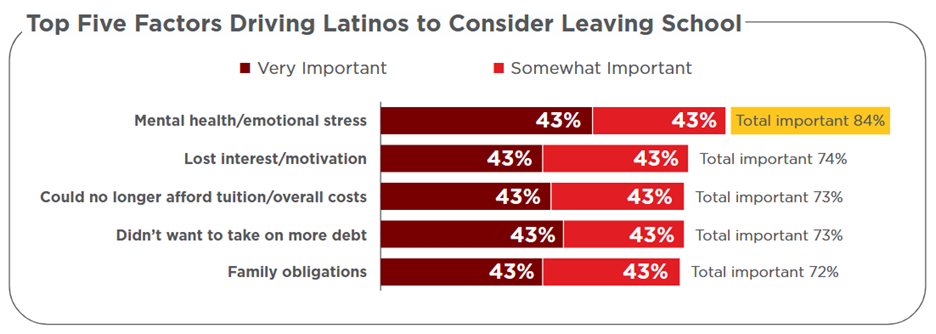
“For more than a decade, students have struggled without the dedicated support they need, such as to address mental stress and the rising cost of college, which would keep them on a path to degree completion,” Sanchez said.
Sanchez also noted that UnidosUS is among many organizations that have pushed for reducing the cost of college as well as for institutional accountability so students are academically and financially prepared to begin their professional careers, grow the U.S. economy and contribute to the greater good of society.
In July, the budget law passed by the Republican majorities in the House and Senate and signed into law by President Donald Trump slashed $284 billion in federal education funding alone to pay for tax cuts for the ultrawealthy and increase immigration enforcement. The bill consolidated student loan programs, capped graduate borrowing, and cut Medicaid and the Supplemental Nutrition Assistance Program. This will make going to college more expensive for low-income Latinos, potentially blocking access to well-paying careers such as medicine or law.
Then last month in October, the White House announced plans to cut $350 million from the funding it provides to all minority-serving institutions, arguing, in their opinion, that restricting eligibility to funding for institutions that meet certain so-called “ethnic or racial quotas” is unconstitutional. This mischaracterizes how HSIs work, as HSIs and other MSIs serve students of all backgrounds who meet the same admissions grounds, regardless of race or ethnicity.
“These divisive attacks are contrary to Johnson’s vision of a college and university system that provides a welcoming and academically rigorous experience for everyone, a place where students and professors can openly discuss history and look together toward ways to improve their lives and their communities,” said Sanchez.
The future of accessible higher education hangs in the balance. While the current federal administration undermines decades of progress, UnidosUS remains committed to staying true to Johnson’s original vision of ensuring a quality higher education for people of all backgrounds backed by robust federal funding.