An invisible but powerful economic engine: the $1.3 trillion impact of U.S. Latinas
By: Lisette Orellana Engel, Director, Economic Policy Project
Summary: Latinas are the primary growth engine of the American workforce, launching the largest number of new businesses compared to any other demographic. Yet they still face challenges to achieving economic prosperity, such as serving as the primary caregiver for children or aging parents and the persistent wage gap.
American Latinas are workers, business owners and spenders, and their economic impact is bigger than one may think. If U.S. Latinas were their own state, they would be the fourth largest economy in the nation — surpassing the entire economic output of Florida.
Keep up with the latest from UnidosUS
Sign up for the weekly UnidosUS Action Network newsletter delivered every Thursday.
Latina entrepreneurship is a well-hidden secret, but that doesn’t make it any less of an economic driver. In fact, Latinas are no longer just a segment of the American workforce; they are its primary growth engine. U.S. Latinas launch the largest number of new businesses compared to any other demographic. From a $1.3 trillion contribution to U.S. GDP to a business-opening rate that leads the small business sector nationwide, the message for 2026 is clear: simple when Latinas succeed, the entire U.S. economy wins.
A trillion-dollar powerhouse for spending and economic growth
Behind the $1.3 trillion Latina contribution to the U.S. economy is something that is often overlooked: the extraordinary spending and earnings of Latinas as a whole.
From 2010 to 2021, the economic contribution of Latinas increased by more than 51% — 2.7 times the rate of non-Hispanic GDP over the same period. Hispanics now comprise 19% of the U.S. civilian labor force, with their numbers growing at more than 10 times the rate of the non-Hispanic workforce since 2003.
The rise of the “Latina-preneur”
Latinas are rewriting the rules of American entrepreneurship. Over the past five years, the number of Latina-owned employer businesses grew by 82% — the fastest growth rate among any demographic group — with more than 121,000 Latina-owned firms now generating over $120 billion in annual revenue and employing nearly 900,000 workers nationwide.
This surge isn’t limited to states with large Latino populations, as Latinas are launching businesses at a rapid pace across the entire country. But structural barriers follow them in a flawed system that is not set up to support their business development: less than 1% of venture capital dollars reach Latina entrepreneurs, and many face systemic disadvantages in accessing procurement contracts and capital. For many Latinas, starting small businesses allows them to increase their income but does not build generational wealth.
Working two shifts, but getting paid for just one
The GDP numbers are striking but the statistics miss a significant part of the picture: the annual value of unpaid care provided by Latinas is $133 billion. Latinas are more likely to live in multigenerational households and serve as primary caregivers for both children and aging parents, often simultaneously, in what researchers describe as “sandwich generation” pressure. Latinas also have more children than the average U.S. household, and for each additional child in their family, Latinas face a 28% reduction in total personal income.
In the United States, nearly two-thirds of Latinos work in low-wage jobs that offer few or no benefits, and only 18% Latinas have access to jobs with employer-sponsored benefits. Plus, more than half of Latinas are unable to earn a single paid sick day through their jobs making them one of the largest demographic groups who lack benefits. The care that Latinas provide keeps communities running, but it doesn’t build a retirement account, and it doesn’t show up in a paycheck.
A wage gap that will not close
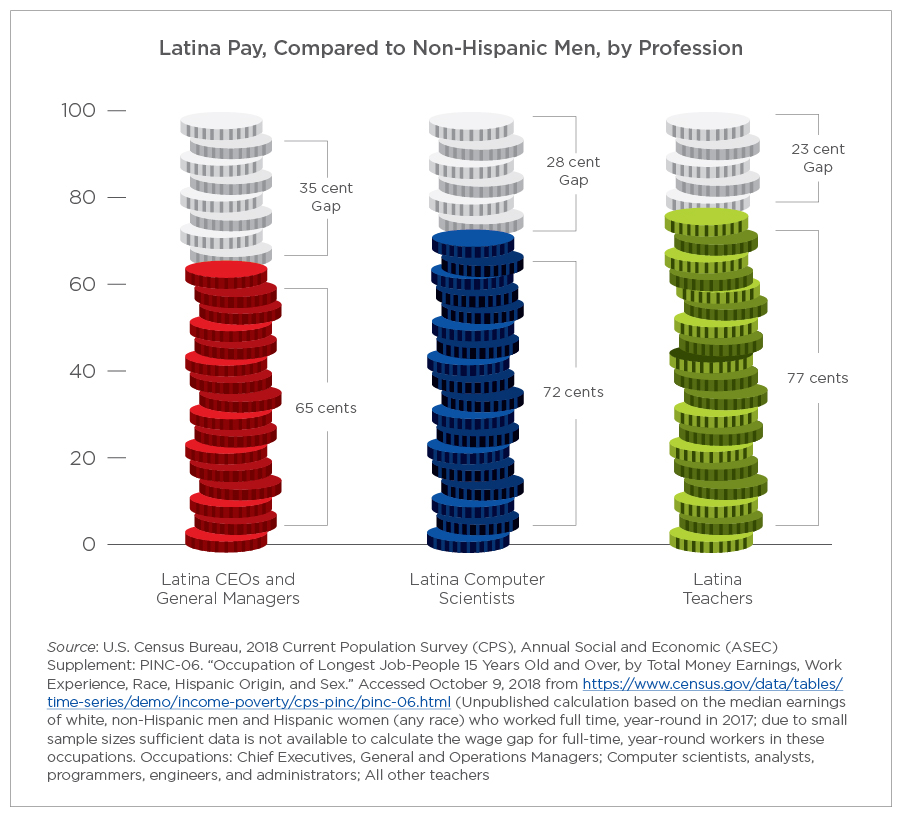
The wage gap remains the single biggest obstacle to Latina economic power, but the numbers tell a story of stalled progress. Latinas who are working year-round full-time jobs are paid 58 cents for every dollar paid to white, non-Hispanic men — and when part-time and seasonal workers are included, that figure drops to 54 cents. Over a 40-year career, that gap adds up to $1.2 million in lost earnings for the typical Latina worker.
Despite Latinas doubling their college attainment over the last two decades, they also remain the lowest-paid major demographic group in the nation’s workforce earning a median wage of $17 an hour compared to $25 per hour for all men.
In short, Latinos work more and earn less — and Latinas carry twice that burden. Based on current U.S. trends, it will take until year 2160 for Latinas working full-time to reach pay equity with white men. While Latino contributions have grown drastically, the pay and access to benefits has not kept pace.
Supporting Latinas is beyond good business—it’s an economic necessity
Supporting Latinas isn’t a matter of social equity alone — it’s an economic imperative. Between 2010 and 2023, Latinos contributed an average of 726,000 workers every year to the U.S. labor force and were responsible for 58.7% of its total growth. Latinas are the engine driving the machine.
This Women’s History Month, we shouldn’t just celebrate what Latinas have already accomplished, although this history is important. We should also recognize what Latinas are doing every day: building our shared economic future. Closing the wage and wealth gap is a key component to unlocking the economy and Latinos next chapter of American prosperity. As UnidosUS’s research on the Latino working class has shown, Latinos and Latinas have long been the backbone of essential industries. Latinos aren’t just joining the economy; they’re leading it.